Leaving Flint to See America: Wandering Wheels and a Schwinn Bike
Leaving Home: Wandering Wheels
It was early June 1972. In a few weeks I’d walk in a graduation line and collect a high school diploma. Life in Flint had finally started to click. I had a girlfriend, my own car, and a decent job. For a seventeen‑year‑old in a blue‑collar town, that felt like the whole package.
What more could I want?
Everyone around me seemed to have an answer: it was time to leave home and “figure out my future.” When they said future, they meant college, careers, maybe another city. When I said future, I meant next Friday night and whether I had gas money for a date.
I felt that pressure to blaze a new trail. But leaving home wasn’t just an idea; I already knew what it meant to go.
Two summers earlier, I had left Flint in a way that changed how I saw everything—not in a car or on a Greyhound, but on a bicycle.
In the summer of 1970, I joined a group called Wandering Wheels out of Taylor, Indiana. It was a small Christian cycling ministry that, starting in the 1960s, took young people on cross‑country rides as a way to stretch their bodies, their faith, and their sense of the world beyond their hometowns. We were headed from Huntington Beach, California, to Rehoboth Beach, Delaware.
Sea to shining sea.
On two skinny tires.
My mother drove me to Detroit Metro for my first airplane ride. She hugged me at the gate and watched me walk down the jetway toward a flight to Los Angeles. She didn’t think I was leaving home for good. She knew I was leaving to learn something about myself and that I would be back.
Before I boarded, she said something she’d said to me many times growing up in Flint:
“Art, see how the other half lives.”
It took a long time to understand what she meant by “the other half.” I’d spent my life in a blue‑collar city surrounded by people from all over Hillbilly Nation. I didn’t need to leave Flint to see that half. The half my mother wanted me to see was different: other cultures, other landscapes, other ways of being.
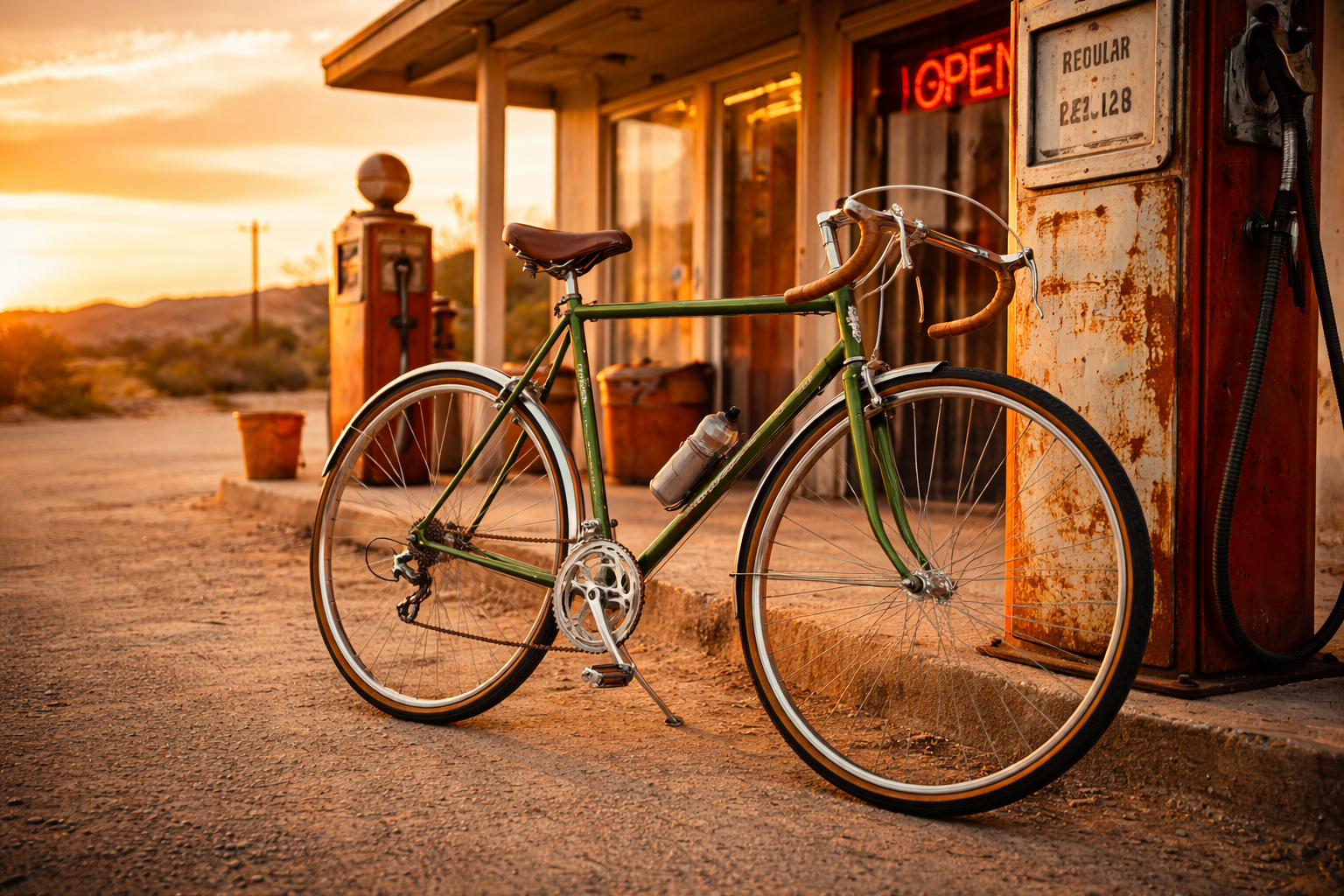
So I flew west with a brand‑new green Schwinn Super Sport—one of the steel road bikes built during Schwinn’s Chicago heyday, when it dominated American bicycle manufacturing—and I still have it today, rebuilt good as new. That Chicago‑built frame has carried me over hills and highways in Michigan, Virginia, North Carolina, and back again, outlasting most of the factories that once defined my hometown.
I was sixteen. The longest ride I’d taken until then was around the Dixieland subdivision—four small hills that felt big at the time. Those hills were decent training for the flatlands of Kansas. They did nothing to prepare me for the Rocky Mountains.
If you want to know why I was ready to leave Flint, you have to understand the soundtrack. I grew up under clouds of factory smoke drifting over our house almost every day. On the radio and in the movies, the 1960s and early 70s offered a different horizon: hit the road, roll into some other town, find out who you are somewhere else.
Films like Easy Rider and a hundred highway songs romanticized escape. What stuck with me wasn’t the drugs or the rebellion so much as the scenery and a simple idea: a river flowing toward the sea, a man wanting to go wherever that river went—anywhere but where he was.
Rolling into some other town sounded perfect. The problem was money and wheels. When the chance came to cross the country with Wandering Wheels, sleeping in churches and parks, pedaling a hundred miles a day, it didn’t feel crazy. It felt inevitable.
We started in Southern California. Riding a loaded bicycle out of the Los Angeles basin taught me that postcards lie. The smog was thick, the traffic relentless. We wound through the foothills near San Bernardino, climbing and climbing, lungs burning. My four little hills in Flint hadn’t prepared me for that.
We pushed on into the Sierra Nevada foothills, then toward the desert on the way to the Grand Canyon. That’s where I first felt how big America really is—and how small you can feel in the middle of it.
We rode through small northern Arizona towns like Kingman, Seligman, and Williams. On a map they’re dots. On a bicycle they’re lifelines. The distance between them is hot, empty, and humbling. Singing “America the Beautiful” doesn’t tell you how far it really is from sea to shining sea. Riding it does.
Somewhere before Flagstaff the romance started to peel away. I found myself talking out loud, arguing with myself on the road.
“Arthur, trying to ride a bike across America is a ridiculously nutty idea.”
“If you ever think about adventuring across America again, do not do it on a bicycle.”
Then another voice in my head chimed in:
“Maybe I’ll do it on a motorcycle instead.”
Even at sixteen I knew that was a dumb idea too.
I kept pedaling.
Crossing the Mojave Desert taught me more about survival than any classroom in Michigan ever did.
Until then, my only desert experience came from television shows like Death Valley Days. On screen, the desert was a backdrop. In June, on a bicycle, it becomes the main character.
We had to ride at dawn and after dark to avoid the worst of the heat. We passed through towns that sounded made‑up: Yucca Valley, Twenty‑Nine Palms, Needles. One night in Twenty‑Nine Palms, we slept in a public park. Around two in the morning I woke up to water pounding my face and sleeping bag. For a moment I thought it was raining. Then I realized the automatic sprinklers had kicked on. By sunrise, everything was dry again. The air was so arid it stole the moisture right out of our gear.
Riding at night brought its own hazards. The road was littered with rattlesnakes. They crawled out to lie on the warm asphalt and soak up the heat. Many were already flattened by trucks and cars. But not all of them. As we slalomed through that mess of living and dead snakes, I kept thinking: this is not how I want to die, bitten by a rattlesnake on a highway no one in Flint has ever heard of.
The days were worse. One afternoon it was about 110 degrees. The air was so dry you couldn’t sweat. That sounds impossible if you’ve spent summers in Michigan humidity, where the air feels like a wet towel. In the Mojave, my skin burned and my mouth turned to sandpaper, but there was no sweat. Just heat, thirst, and the road.
I learned something that day I’ve carried into every hard fight since: you can do more than you think you can, as long as you don’t quit.
The moment that lesson really sank in was when we finally saw water again.
We crossed into Nevada and reached the Colorado River and Davis Dam, just north of what’s now Laughlin. After miles of shimmering heat, that blue‑green water looked like a hallucination.
I dropped my bike, walked to the river, and poured cold water over my head. It shocked my skin and cleared my thoughts. I was three hundred miles from where we’d started at the Pacific and roughly two thousand miles from home. I was sixteen. For the first time in my life, I felt truly on my own.
From that point on, the trip wasn’t about adventure or some movie soundtrack. It was about survival and getting to the next stop.
There’s one last image from that stretch that has stayed with me for more than fifty years.
We were somewhere out in that wide, empty country. Tumbleweeds, scrub, dust, heat. We needed water. We came upon a shack with a corrugated metal roof, the kind of place you’d expect in a Western. Inside were two men standing over a big metal trough—the kind you use to water cattle—with a huge fan blowing across it.
They filled my water bottle. I asked what the contraption was.
“That?” one of them said. “That’s a desert cooler. Poor man’s air conditioner.”
I had never seen anything like it in Michigan. Back home, we already had humidity. Pumping water into the air would make you feel worse, not better. In that shack, in that climate, this cheap setup was the difference between unbearable and just barely tolerable.
As they talked, my mind drifted back to Flint—to my dad sitting in front of his window air conditioner, listening to Ernie Harwell call the Tigers game on the radio. The whirr of the fan, the crack of the bat, Harwell’s easy voice. In that moment, Flint felt both impossibly far away and completely present. I was in a desert, but I was also home.
Years after that first ride, the bike carried me along the mountain roads of Virginia and North Carolina and around the Leelanau Peninsula in Michigan. One stretch of road I cherished most wasn’t technically a ride at all: crossing the Mackinac Bridge in the bed of a Michigan Department of Transportation pickup, lying under what felt like a billion stars.
Bicycles aren’t allowed on the bridge. Once a year, on Labor Day, it opens to pedestrians for the Mackinac Bridge Walk, a five‑mile tradition that’s been led by Michigan governors since the late 1950s and now draws tens of thousands each year. I promised myself I’d come back to that span on my own power. In 2013, I did—joining thousands of other Michiganders to walk across the bridge on Labor Day, trading the hum of tires for the rhythm of footsteps and conversation.
By then I knew a few things. This country is bigger than any one town. Heat and distance can strip you down to your basics. And no matter how far you travel—from a desert shack with a poor man’s air conditioner to the Mackinac Bridge under a sky full of stars—the place you’re from rides along with you.
I didn’t understand it then, but that summer on the bike was rehearsal for every hard thing that came later—law school, politics, the Flint water crisis, and the long project of not giving up on a city that taught me both how to endure and how to leave. Mom was right: I did see how “the other half” lives. What neither of us could have predicted was how much those roads, and that old Chicago Schwinn, would change the way I see our half too.
Founder and Host of Radio Free Flint Podcast
Arthur Busch is a veteran lawyer and educator with an acclaimed record of success in high-profile cases. He was a Prosecutor and community leader for decades.
Arthur Busch grew up in rust belt Flint, Michigan, just three blocks from the former General Motor's Fisher Body Plant #1. The auto factory was the site of the historic sitdown strike that gave birth to the United Automobile Workers Union.
Mr. Busch holds a BA in Urban Public Policy, and a Masters's Degree in Labor and Industrial Relations from Michigan State University as well as a Juris Doctorate from Thomas Cooley Law School in Lansing, Michigan. He attended Flint Public Schools.

Snowbirds, Split Lives, and the Meaning of Michigan My Home


