Flint at a Crossroads: Broken Systems, Lost Trust, and the Fight for a Viable Future
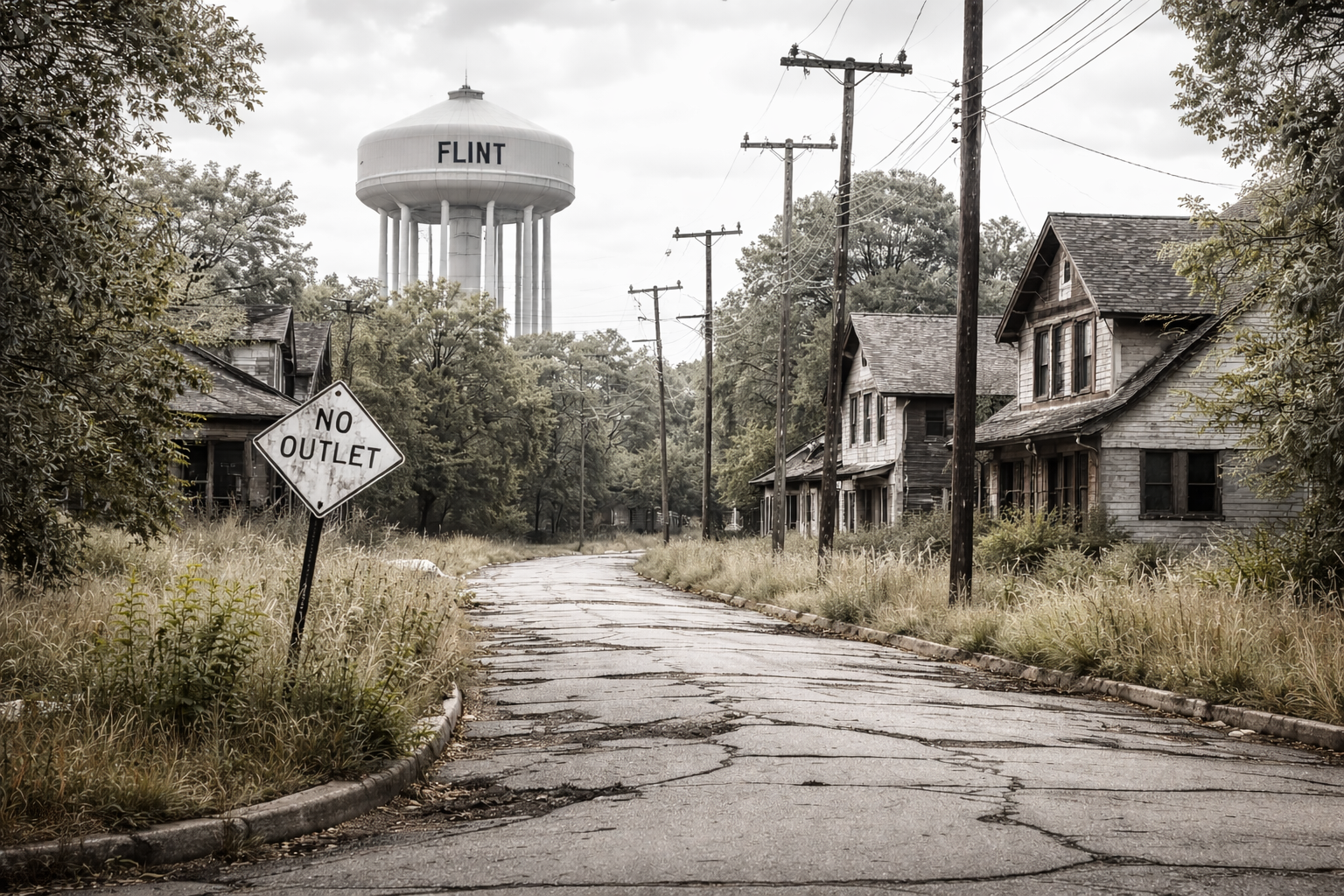
Part I – Flint at a Crossroads: Broken Systems and Lost Trust
Flint begins each new year with a paradox. The city is both a national symbol of failure and a place full of people who refuse to give up. Once a thriving industrial hub, Flint has endured deindustrialization, poisoned water, entrenched poverty, and racial segregation. Yet it still holds real assets and the possibility of a quite different future. What will decide which path we take is not just factories, foundations, or state appointees, but the kind of leadership Flint chooses—and demands—for itself.
The water crisis and collapse of trust
The Flint water crisis remains the most visible wound. In 2014, the city switched its drinking water source from Detroit’s system to the Flint River to save money, without properly treating the water. Lead and other contaminants flowed into homes. Families opened their taps and poured out water that could harm their children’s brains and bodies. Many still rely on bottled water for drinking and cooking. The health and developmental consequences will last for decades.
The legal aftermath deepened the sense of betrayal. An emergency manager appointed by the state was indicted for his role in the crisis, but the case was dismissed on procedural grounds before the public could see a full airing of the evidence. Residents who watched their children drink contaminated water see that as one more example of a system that never finishes the job when powerful people are involved. It is hard to ask a community to “move on” when it has never seen a complete, transparent reckoning.
At the local level, the City of Flint has cycled through accusations of financial mismanagement, including allegations that taxpayer funds were used in violation of the Flint City Charter. Public meetings often feature more spectacle than strategy. A visit to certain City Council or Board of Education meetings can leave the impression of immature political behavior out of step with the seriousness of the city’s problems. Ordinary residents watch and came away convinced their leaders are not focused on the long technical work needed to fix a broken city.
The economy shrunk, but systems that never did
Underneath the politics sits a stark economic reality. Flint has one of the highest poverty rates in the country. The auto industry’s decline cost the city tens of thousands of jobs; many businesses have closed or moved. For years, the local economy has leaned heavily on the pensions and generous health‑care benefits of General Motors retirees. Those dollars have quietly propped up everything from hospital expansion to local retail. As that generation passes, their income and health‑care spending disappear with them, leaving the community a little poorer each day.
What has not shrunk in proportion to the population is Flint’s physical plant. The city now has some of the most extensive vacant industrial lands in the world—served by industrial‑sized water mains, rail lines, freeways, and roads built to feed a manufacturing giant that no longer exists at that scale. Former public works and transportation leaders have estimated that fixing Flint’s roads and decrepit water lines would cost hundreds of millions of dollars. Flint does not have that kind of money, and no realistic forecast suggests a sudden rush of heavy industry is coming to refill the empty plants.
This mismatch matters for both finances and public health. Underutilized water lines sit with low flow, which can contribute to stagnation and water quality problems, as the city learned during the water crisis. Maintaining miles of overbuilt roads and utilities for a much smaller city diverts scarce dollars from things that could improve quality of life. Continuing to act as though “old Flint” will return is fiscally irresponsible and dangerous.
Downsizing infrastructure—closing and decommissioning some lines and streets, consolidating service areas—is often treated as political suicide. It may be the only way to stabilize Flint’s finances and protect residents. Leaders must urgently consider the public‑health risks of continuing to push water through an excessive, underutilized system while postponing a serious downsizing plan.
Race, segregation, and who gets left behind
Flint’s racial segregation is not just a moral issue; it is an economic and governance problem. Flint is a majority‑Black city, with many neighborhoods highly segregated by race and income. A long history of discriminatory housing practices, school district boundaries, and local government lines has concentrated poverty and limited access to opportunity for Black residents.
The people and leaders in the greater Flint area too often fail to see segregation in education, housing, and employment as a collective regional problem. When the region treats segregation as “Flint’s problem” instead of a shared responsibility of Flint, its suburbs, and Genesee County, everyone loses. Segregated neighborhoods tend to have weaker schools, fewer job connections, and lower property values. That means a weaker tax base, less capacity for local government, and higher social costs over time. Businesses considering relocation or expansion look not only at tax rates and land prices, but also at the depth and diversity of the talent pool and the region’s reputation. A metro area that appears unwilling to confront segregation and concentrated poverty will struggle to attract and retain the people and firms that drive modern economies.
Debates in the Flint area often get stuck on whether there is “too much government” or “too little government,” instead of asking whether our patchwork of authorities and school systems is locking in segregation and economic stagnation. The number of local units matters less than whether they share a realistic vision and are willing to act together on housing, education, transportation, and land use.
These failures—in water, infrastructure, race, and governance—did not happen in a vacuum. They happened in a city where the loudest voices and deepest pockets often stood outside formal democracy. The question now is whether Flint can reclaim its future from a mix of philanthropic paternalism and political drift. That is the work of Part II.

Founder and Host of Radio Free Flint Podcast
Arthur Busch is a veteran lawyer and educator with an acclaimed record of success in high-profile cases. He was a Prosecutor and community leader for decades.
Arthur Busch grew up in rust belt Flint, Michigan, just three blocks from the former General Motor's Fisher Body Plant #1. The auto factory was the site of the historic sitdown strike that gave birth to the United Automobile Workers Union.
Mr. Busch holds a BA in Urban Public Policy, and a Masters's Degree in Labor and Industrial Relations from Michigan State University as well as a Juris Doctorate from Thomas Cooley Law School in Lansing, Michigan. He attended Flint Public Schools.

Snowbirds, Split Lives, and the Meaning of Michigan My Home


