Fear of Aging in Politics: Media, Dementia and Older Voters in Michigan
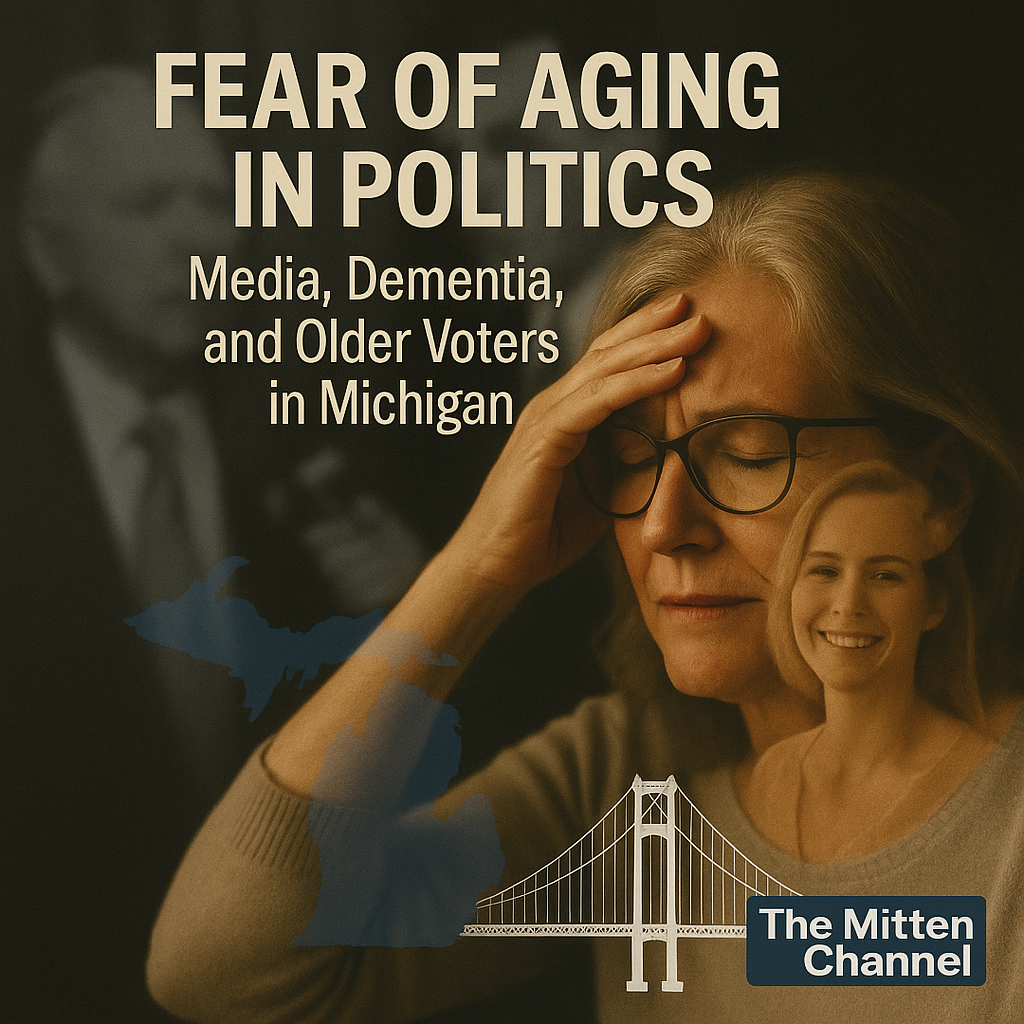
In Michigan living rooms, from Flint to Saginaw, older residents turn on the news. They often see something they never asked for: aging men turned into a spectacle.
The screen shows familiar figures like Donald Trump, Joe Biden, or John Fetterman. Every stumble, slurred word, or frozen expression gets clipped, replayed, and mocked. It is all dissected under one cruel question: Is he losing it?
Younger viewers might see this as simple background noise. But for older viewers in Michigan’s aging cities and towns, it is much more personal. It feels like a nightly test of what it means to grow old. In America, any sign of cognitive weakness is often treated as a spectacle and a sport.
Michigan’s Aging Front Line
Michigan has quietly become one of the oldest states in the Midwest. This change is most visible in two areas:
- The post-industrial corridor: This includes Flint, Saginaw, Bay City, and older Detroit suburbs.
- The up-north counties: Here, retirees and long-term locals age in place near lakes and small towns.
In the Tri-Cities and Genesee County, many older residents have health problems from factory work. They also carry the economic shock of plant closures. Flint residents, in particular, face the added trauma of the water crisis.
Up north, in places like Roscommon, Alcona, and Presque Isle counties, populations are smaller and older. Hospitals and specialized services are often far away. The television is often on for company as much as for news.
In these communities, late life often features chronic illness, loneliness, and financial strain. Research shows older adults in these areas have higher rates of anxiety and depression. They follow political news closely. Government decisions feel directly tied to their pensions, health care, and basic survival.
When the news shows older leaders "slurring," "stumbling," and being "unfit," it is not just covering a political race. It is a constant reminder that people their age are on trial. They are on camera, in front of the whole country.
Fear of Dementia and the Silent Self-Audit
Psychologists who study aging say older adults judge their own health through social comparison. People in their sixties, seventies, and eighties constantly compare their memory, walk, and alertness to others their age. They do this silently, perhaps at church, at the store, or in the doctor’s waiting room.
When they feel they are doing better than their peers, they feel younger and less anxious. When they feel they are doing worse—slower, foggier, or more dependent—the comparison increases their fear. It makes them feel "old" in the most unsettling ways.
The fear of dementia drives this process. Many older adults see dementia as the most dreaded version of late life: losing one’s mind, independence, and place in the family. High fear of memory loss lowers a person's quality of life. It increases depression and self-stigma, even for people with normal cognitive test results.
When TV turns every verbal slip by an older president into a question of "dementia," the older viewer is not just judging the man on the podium. They are silently checking their own missed words and misplaced keys against him. They are wondering if they are seeing their own future happen in real time.
"Cognitive Snuff" and Invisible Harm
Media scholars note that dementia coverage often uses a narrow, fear-inducing visual language. Images often show very old, dependent people who look vacant or are shown alone. These portrayals suggest that cognitive decline is total erasure. This leaves no room for people who live meaningful lives with mild symptoms.
This imagery causes stigma. It makes many older adults delay seeking help. They cannot bear to be seen as "one of those people."
We already agree that some media—like graphic violence—is too dangerous to show over and over. Research links repeated exposure to violent or crisis-laden media to higher anxiety and trauma-like symptoms.
But we have not fully faced a quieter parallel for older viewers. This is an endless loop of humiliating clips showing aging political leaders. They show confusion and age, presented as entertainment or partisan attack.
We can call it cognitive snuff. It does not show blood, but it shows something just as personal: the erosion of dignity, which is looped for everyone to consume.
The Damage Is Inward and Quiet
The harm does not hit all at once. It spreads inward and quietly. Studies show that people who fear highly cognitive decline are more likely to withdraw socially and hide symptoms.
Research on political stress shows that older adults who watch a lot of conflict-heavy news report more trouble sleeping and greater feelings of helplessness.
In a Flint bungalow or a Roscommon cottage, this harm takes everyday forms: late-night scrolling that brings fear, arguments over politics, and a growing belief that one’s own aging body and mind are a burden.
Consequences for Democracy
None of this stays inside the living room. Political experts say that long exposure to negative, high-conflict politics pushes some people to withdraw. They turn off the news, skip elections, and disengage. It also makes others more likely to be swayed by appeals based on fear.
Michigan, along with Wisconsin and Pennsylvania, is more than just a swing state. It has one of the oldest groups of voters in the Midwest. Older voters show up reliably and often decide close races.
If these voters are constantly taught that their age and weakness make them ridiculous, dangerous, or unfit, then the foundation of democracy is damaged.
Looking Ahead
With major elections coming in 2026 and 2028, Michigan will be in the spotlight. As one of the states with the fastest-growing senior populations, questions about age and fitness will intensify. These issues will shape campaign messages and media stories. They will influence how candidates target voters with appeals that play on fear, not understanding.
This is a serious concern. As the Baby Boomer generation moves deeper into their seventies and eighties, anxiety about memory loss and independence will define civic life. This is especially true in Michigan, where older voters are numerous and decisive.
The danger is not that we talk about these topics. The danger is that we talk about them carelessly. They are reduced to ridicule and spectacle. This ignores the psychological impact on the very people who are most affected.
At its core, this is not just a political issue. It is a matter of public well-being.
Just as young people can be triggered by repeated violent images, older adults can be triggered by constant portrayals of aging as humiliation. Fear of decline does not follow party lines. Cognitive disorders do not recognize political ideology.
A society that limits some media to protect children should ask if it owes similar care to its elders. The question for Michigan—and the country—is not whether we should examine aging leaders. The question is whether aging itself must be treated as a form of public spectacle. How we answer will shape future elections and the mental health of an aging democracy.

Founder and Host of Radio Free Flint Podcast
Arthur Busch is a veteran lawyer and educator with an acclaimed record of success in high-profile cases. He was a Prosecutor and community leader for decades.
Arthur Busch grew up in rust belt Flint, Michigan, just three blocks from the former General Motor's Fisher Body Plant #1. The auto factory was the site of the historic sitdown strike that gave birth to the United Automobile Workers Union.
Mr. Busch holds a BA in Urban Public Policy, and a Masters's Degree in Labor and Industrial Relations from Michigan State University as well as a Juris Doctorate from Thomas Cooley Law School in Lansing, Michigan. He attended Flint Public Schools.

Snowbirds, Split Lives, and the Meaning of Michigan My Home


