Demolition Alone Will Not Save Flint
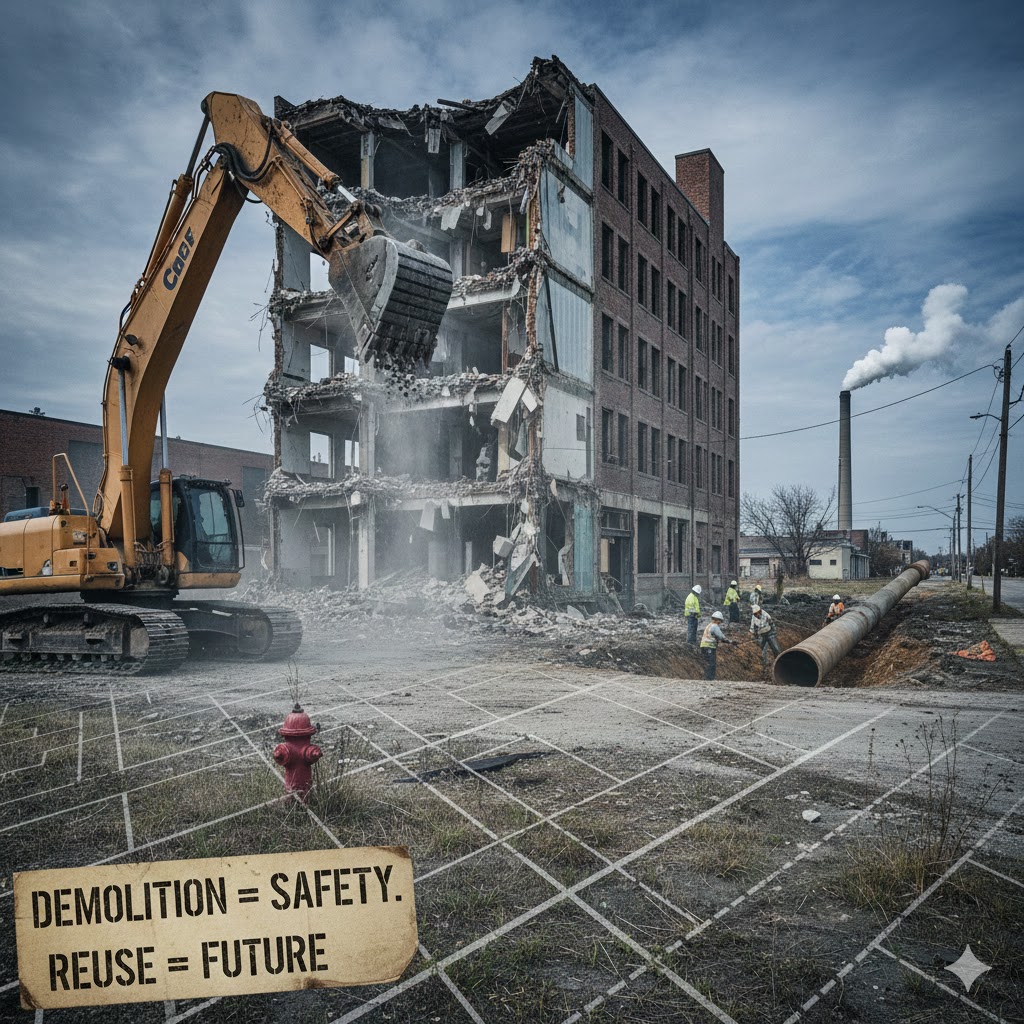
Demolition alone will not save Flint.
On the west side, the hulking shell of Westwood Manor used to loom over Clio Road—a burned‑out, vandalized complex that neighbors had to live with for years. The Genesee County Land Bank finally took it down in 2025. The bricks are gone. The broken windows are gone. The calls for fires and trespassing are gone. But underneath that now‑open field, the same water lines, sewers, and streets still run as if hundreds of people lived there. The city is still pumping treated water past an empty lot.
That gap—between what we see at ground level and what we pay for underground—is at the heart of the problem facing Flint, Detroit, and other deindustrialized “legacy cities.” Demolition has made blocks safer and more livable. But demolition by itself cannot dig a city out of deindustrialization, especially when the pipes and roads built for twice as many people are still in the ground. The real question is not whether to tear down. It is whether we pair that teardown with reuse and a deliberate shrinking and re‑focusing of our infrastructure, or whether we simply mow vacant lots over stranded systems and call that progress.
What demolition actually fixes
Flint and Genesee County are a national case study in how to attack blight at scale. The Genesee County Land Bank and its partners have demolished nearly 10,000 structures and taken responsibility for tens of thousands of vacant lots. Researchers who followed this work did not find that demolition was meaningless. On the contrary, they documented concrete public‑safety and neighborhood benefits.
According to an analysis prepared for Genesee County and summarized by Michigan State University–affiliated researchers, removing the worst abandoned houses and maintaining the resulting lots slowed the collapse of nearby property values and reduced the spillover damage to occupied blocks. The same research found that residents reported higher feelings of safety and neighborhood pride when the most notorious structures were finally razed and the land kept clean and green.
A separate study highlighted by the Center for Community Progress looked closely at Land Bank ownership and stewardship of vacant lots. It found that streets with Land Bank “Clean & Green” lots—regular mowing and basic care by neighborhood groups—experienced roughly a 40 percent reduction in some categories of violent crime compared with similar streets where abandonment was left unmanaged. The conclusion was not that demolition solved poverty or brought back auto plants, but that, done strategically and maintained, clearing the worst properties made measurable differences in safety and stability.
For people who lived next to a burned‑out duplex or behind a house stripped down to its studs, those changes are not abstract. Demolition gets rid of places where assaults and fires happen. It tells residents someone is willing to invest in their block. It can be the first step in making a street feel like a neighborhood again.
But as Flint’s own experience shows, that is only the first step.
The invisible infrastructure trap
Beneath every demolished house in Flint and Detroit lies the same basic infrastructure that was installed when the city still believed it would keep growing forever. Streets laid out for full blocks. Hydrants at every corner. Water lines big enough to serve multiple families per lot. Sewers sized to carry stormwater and waste for a population that, in some cases, has been cut in half.
A right‑sizing study of Flint’s infrastructure, published in the wake of the water crisis, made the point bluntly: the bones of the system were built for more than 200,000 residents, but fewer than 100,000 live there now. Yet the city still has to pump, treat, and move water through a network designed for twice as many customers. Fixed costs—treatment plants, trunk mains, pump stations—do not shrink just because residents leave. They get shared among fewer people, driving up per‑household costs and straining already low incomes.
The same study warned that any plan to “right‑size” that infrastructure comes wrapped in hard questions about fairness. If you decide to abandon certain pipes or stop maintaining certain streets, which neighborhoods lose first? The researchers cautioned that if those decisions are made solely on technical or fiscal grounds, without a justice lens, they will fall hardest on the same Black, low‑income neighborhoods that have historically borne the brunt of disinvestment and environmental harm. Right‑sizing, they argued, can become a new form of redlining if it is not anchored in community voice and civil rights.
That is the trap: clearing vacant houses without touching the infrastructure leaves cities paying to maintain empty capacity they cannot afford. Trying to shrink the system without equity can repeat the very injustices the water crisis exposed. The easy political move is to stop at demolition and leave the tangle of pipes and roads out of the conversation.
Beyond “tear down and wait”: Flint’s and Detroit’s frameworks
Flint has at least tried to push beyond pure teardown. The city’s “Beyond Blight” strategy, developed in partnership with the Center for Community Progress, is explicit that demolition is only one part of the job. The framework sets targets not just for tearing buildings down but for reusing vacant land and bringing existing properties back into compliance. For example, one version of the plan called for demolishing thousands of derelict structures, reusing roughly 5,000 vacant lots, and moving 95 percent of remaining properties into code compliance over five years.
That matters, because it treats each cleared parcel as a future asset, not just a cost center to mow indefinitely. Some lots become side yards for neighbors who want more space and are willing to take responsibility for it. Others become community gardens or small parks. Still others are reserved, on paper, for future infill housing or small‑scale commercial uses in corridors where the market and infrastructure can still support it. The framework does not magically solve Flint’s fiscal crisis, but it forces everyone—city hall, land bank, funders—to talk about reuse, not just removal.
Detroit has been grappling with the same questions at a bigger scale. With more than 100,000 vacant parcels and thousands of demolitions under its belt, the city has experimented with “right‑sizing” concepts and detailed vacant‑land adaptation plans. One city‑backed report on “G7” neighborhoods, for example, mapped where traditional housing investment still made sense and where it would be more realistic to shift toward greenways, stormwater projects, or long‑term open space. The idea is not to abandon people, but to stop pretending every block can or should be rebuilt to 1950 levels.
These efforts are tentative and politically fraught. Residents reasonably worry that being labeled a “green” area is just a polite way of saying their neighborhood will never see serious housing or infrastructure investment again. Advocates worry that vacant‑land plans can become a cover for land grabs. But compared with a pure demolition strategy, they at least confront the full picture: land, people, and the buried systems tying them together.
Why demolition plus a plan beats demolition alone
“Tear down and hold” has obvious appeal. It is visible. It is fundable. Federal and state dollars have flowed more readily for bulldozers than for re‑plumbing a half‑empty grid. For local officials, being able to tell residents “we took that house down” is politically powerful. For residents living next to a firetrap, it is an immediate relief.
The research makes clear that those benefits are real. Demolition and basic lot care reduce crime, protect occupied homes from fires, and keep neighborhoods from tipping into complete abandonment. In the short term, for public safety and mental health, “tear it down” is often the right answer.
But the same work done in Flint, Detroit, and other legacy cities also makes clear that demolition alone functions as triage, not cure. Without a reuse strategy and some form of infrastructure right‑sizing, cities get stuck in a loop: grant‑funded demolition and mowing on top, aging pipes and roads underneath, and a tax base too small to support either. Reports on Genesee County’s land banking and on vacant‑land efforts across the Midwest emphasize that the most resilient outcomes come where clearing blight is paired with side‑yard sales, garden programs, infill housing, and strategic disinvestment from truly unsalvageable infrastructure, done with community input.
That is the hard part. It is one thing to map out, in a planning document, which streets might eventually be closed or which mains could be looped or abandoned. It is another to tell an actual resident that their block is going to change in ways they did not choose. The Flint right‑sizing studies repeatedly stress that any infrastructure downsizing must be gradual, transparent, and paired with protections for affected residents—not simply a city engineering department quietly turning valves in the name of efficiency.
Digging out, not just digging up
Cities like Flint and Detroit were physically built on the assumption of endless growth: wide streets, long blocks, large lots, heavy‑duty water and sewer systems. That hardware is still there, even after the factories left and the population dropped. Demolition is necessary to undo some of the damage of abandonment and disinvestment. It can make neighborhoods safer tomorrow. It can buy time.
But if the goal is to dig out of deindustrialization—not just dig up foundations—then teardown must be tied to a different kind of rebuilding. The research and the local experiments point in the same direction: use demolition to clear the worst hazards, reuse land in ways that fit today’s population and climate realities, and slowly but openly right‑size the buried systems so that the people who remain are not paying to maintain a ghost city under their feet.
Anything less risks leaving residents standing where Westwood Manor used to be—looking out over cleaner, safer ground, and still paying for water flowing under a lot that will never be a home again.
For more insight, visit:
Beyond Blight (City of Flint and Center for Community Progress) – on Flint’s blight elimination and reuse framework.
Genesee County Land Bank case study (Center for Community Progress) – on demolitions, Clean & Green, and neighborhood impacts.
Right‑Sizing Flint’s Infrastructure – Flint water and infrastructure study on the costs and equity risks of shrinking systems.
Detroit vacant‑land adaptation reports – on how Detroit is planning reuse and green infrastructure for surplus land.

Founder and Host of Radio Free Flint Podcast
Arthur Busch is a veteran lawyer and educator with an acclaimed record of success in high-profile cases. He was a Prosecutor and community leader for decades.
Arthur Busch grew up in rust belt Flint, Michigan, just three blocks from the former General Motor's Fisher Body Plant #1. The auto factory was the site of the historic sitdown strike that gave birth to the United Automobile Workers Union.
Mr. Busch holds a BA in Urban Public Policy, and a Masters's Degree in Labor and Industrial Relations from Michigan State University as well as a Juris Doctorate from Thomas Cooley Law School in Lansing, Michigan. He attended Flint Public Schools.

Snowbirds, Split Lives, and the Meaning of Michigan My Home


